


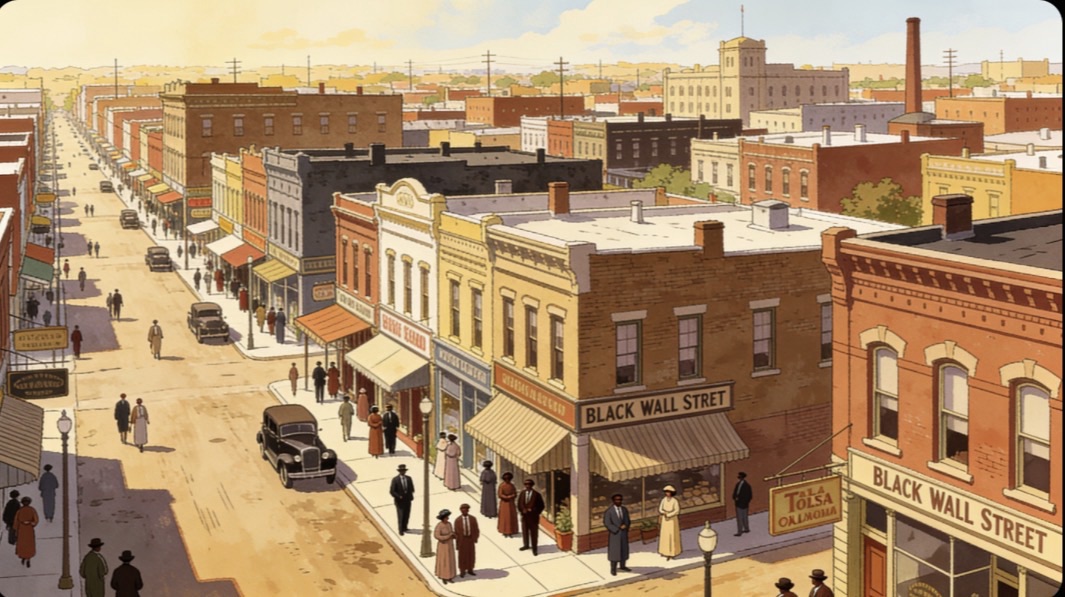
Why Black Wall Street Was Created—and How Greenwood Rebuilt
The story of Tulsa’s Black Wall Street began as part of a much larger movement among Black Americans seeking greater political and economic independence in Oklahoma.
The Vision for Black Political Independence
In the late 1800s, Edward P. McCabe, a Black politician, businessman, and land agent from Kansas, actively encouraged Black Americans to migrate to Oklahoma Territory. McCabe believed that a large Black population could create political power and potentially establish a Black-majority state.
For many Black migrants, Oklahoma represented an opportunity to escape the racial violence, discrimination, and restrictive laws they faced in the South. The broader vision was to build communities where Black people could own land, participate in government, establish businesses, and exercise greater control over their economic and political futures.
McCabe’s vision was therefore largely political and territorial: build a strong enough Black population to create lasting political influence.
O.W. Gurley and the Creation of Greenwood
In Tulsa, O.W. Gurley pursued a more localized economic vision. Gurley, a successful Black businessman and landowner, acquired property and helped develop what became known as the Greenwood District.
Greenwood provided Black residents with opportunities to purchase homes, establish businesses, create jobs, and circulate wealth within their own community. Hotels, restaurants, grocery stores, professional offices, entertainment venues, and other businesses helped transform the district into a thriving center of Black commerce.
While McCabe’s efforts focused heavily on Black political power and migration, Gurley’s work in Tulsa focused more directly on economic development and community building.
Greenwood Rebuilds After the 1921 Tulsa Race Massacre
The prosperity of Greenwood was violently interrupted in 1921 when the Tulsa Race Massacre devastated the district. Homes and businesses were destroyed, and many residents lost virtually everything.
Yet Greenwood’s story did not end with the destruction.
Residents returned and began rebuilding their homes, businesses, and community. They faced significant obstacles, including restrictive building regulations and resistance from some city officials. Attorney B.C. Franklin played an important role in challenging efforts that threatened residents’ ability to rebuild.
Despite these challenges, Greenwood’s businesses gradually returned. By the middle of the 1920s, the district had once again developed into a thriving commercial community.
A Story of Economic Resilience
Greenwood’s recovery is one of the most remarkable parts of the Black Wall Street story. The community had suffered enormous destruction, yet its residents continued to invest in their homes, businesses, and institutions.
Rather than abandoning Greenwood, they rebuilt it.
For roughly the next 45 years, Greenwood continued to develop and serve as an important center of Black economic and community life. Its recovery demonstrated the power of entrepreneurship, property ownership, cooperation, and determination in the face of extraordinary adversity.
However, Greenwood’s later history was shaped by forces beyond the 1921 massacre. Urban redevelopment, highway construction, and other changes to Tulsa’s transportation infrastructure disrupted the neighborhood and contributed to the decline of the historic district.
The story of Black Wall Street, therefore, is about more than how Greenwood was destroyed. It is also about why the community was created, how its residents rebuilt after one of the worst episodes of racial violence in American history, and how they continued building economic opportunity for decades afterward.


Leave a Reply